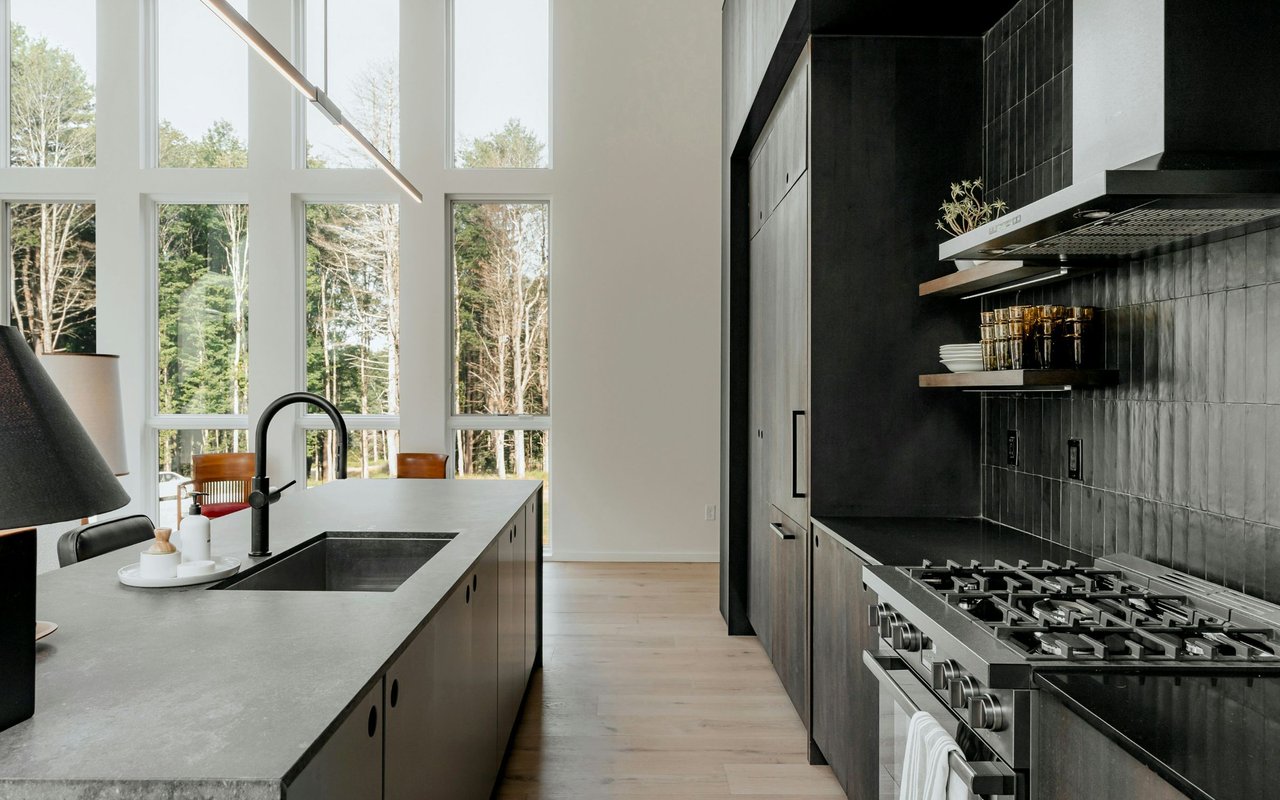
A buyer touring Glenora this summer could walk two blocks in either direction from the same crescent and see almost the same house twice. Same 1940s brick, same steep-pitched roof, same 50-foot lot. One is priced at $1.1 million. The other, four blocks closer to Stony Plain Road, is priced almost identically, even though it sits within a few minutes' walk of a station platform that construction crews are actively building right now.
That gap not existing is the interesting part.
What Everyone Assumes Is Driving Glenora's Price Spread
Glenora's active listings spanned from $100,000 to $3.95 million as of July 22, 2026, with an average asking price near $1.24 million and roughly $575 per square foot on a typical 2,040-square-foot home with 3.5 bedrooms. A separate snapshot taken in late August 2026 broke the market down by property type: homes averaging closer to $1.34 million and condos averaging $531,000, with condo listings alone spanning from a $93,000 low to $1.699 million at the top.
The easy explanation for a spread that wide is the one most buyers reach for first: Glenora was built out over decades, so you're comparing a 1946 character home that needs a full mechanical update to a 2026 infill on a subdivided lot, and of course the prices don't line up. That story is true as far as it goes. Original construction details like leaded glass and deep front porches still show up on listings throughout the neighborhood, and newer builds on severed lots command a real premium over unrenovated originals nearby.
But that story doesn't explain why two homes of similar age, size, and condition can sit at nearly the same price when one of them is a short walk from a station and the other isn't. If age and lot size were the whole story, proximity to a coming LRT stop should already be showing up as a line item in the asking price. Right now, in most of Glenora, it isn't.
The Thing Standing At Stony Plain Road Isn't Priced In
The Glenora Stop is a real, named station on the Valley Line West extension, and it sits inside the neighborhood's own boundaries. As of the city's most recent construction update, crews have installed the platform canopy steel and decorative wood at the Glenora Stop, alongside work on the Stony Plain Road bridge and the Norquest Stop closer to downtown. This isn't a station on a planning map. It's steel and wood going up on a specific corner right now.
It's also not open. The City of Edmonton's own project page states construction is anticipated to be complete in 2028, with an extensive testing and commissioning phase to follow before the line carries a single passenger, and the city has not put a firm date on how long that testing phase will take. Back in February 2025, Marigold's construction manager put the project about a year behind schedule at that point and pointed to 2029 for the Valley Line to be done, against an original five-to-six-year construction target that started in 2021.
That gap between visible progress and actual service is exactly why the premium hasn't shown up yet. Research on transit-linked home values, drawn from infrastructure-impact studies elsewhere, points to gains of 10 to 20 percent for homes within roughly 800 meters of a station once it's running, and separate coverage of walkable condo and townhome buildings near west-end LRT stops points to gains closer to 5 to 10 percent. Those numbers describe what happens after a line opens and buyers can actually use it. Glenora is still in the phase where the closest thing to a benefit is a canopy going up and a lot of orange fencing.
Why The Disruption Is Doing Double Duty
Here's where the mechanism gets interesting instead of obvious. The same construction that's building the future premium is actively suppressing interest in the blocks closest to it today.
Stony Plain Road has been closed and reopened in stages for years as Marigold Infrastructure Partners, the contractor building Valley Line West, has worked through intersection by intersection. According to Global News, Todd Janes, executive director of the Stony Plain Road Business Association, has spent years representing businesses on that stretch through repeated closures. When Edmonton's city council voted to accelerate the construction schedule in early 2025, trading a slower multi-year disruption for shorter, more intense closures, then-Mayor Amarjeet Sohi acknowledged it had been "an ongoing frustration for businesses, for commuters." Marigold's own construction manager, Jonathan Cox, described the approach around individual intersections as an effort to "get in, get out and overall reduce disruptions to the community."
That frustration is rational for anyone trying to run a shop or get to work on time. But it also means the blocks nearest the Glenora Stop are the ones most likely to show up in a buyer's mind as "the construction zone" rather than "the future station," which keeps demand and pricing flat exactly where the eventual station effect should concentrate. The visible cost of construction is being felt today. The invisible benefit of what construction is building won't be felt for at least another year or two, and probably longer once testing is factored in.
Reading Distance To The Glenora Stop Like A Hidden Variable
None of this means every home near the station is a bargain, or that the premium is guaranteed to arrive exactly the way it has elsewhere. Every transit line is different, and Glenora already commands high prices for reasons that have nothing to do with the LRT: mature tree canopy, river valley access, and a location that's a five-to-ten-minute drive from downtown. But it does mean distance to the Glenora Stop is a variable worth checking deliberately rather than assuming the listing price already accounts for it.
| Distance from Glenora Stop | What broader transit research suggests | What it likely means in Glenora today |
|---|---|---|
| Within roughly 800 meters (about 8 to 10 short blocks) | Gains of 10 to 20 percent once a station is operating | Covers a wide stretch of Glenora on either side of Stony Plain Road |
| Easy walking distance for condo and townhome buildings | Separate research on west-end LRT proximity points to 5 to 10 percent gains for walkable multi-family | Relevant to condo buildings closer to Stony Plain Road, including buildings like West Block |
| Beyond comfortable walking distance | No consistent premium shown in the research | Pricing here still tracks the same age, lot size, and condition factors that have always driven Glenora values |
The takeaway isn't "buy near the station and wait." It's that a buyer comparing two similar Glenora homes right now should ask a different question than the one the listing photos invite. Instead of only asking what year it was built and how big the lot is, ask how many blocks separate the front door from a platform that's already under steel.
What To Actually Check Before You Assume The Price Reflects The Station
- Pull up the block and check its walking distance to the Glenora Stop specifically, not just general proximity to Stony Plain Road, since the corridor runs the length of the neighborhood
- Check Marigold Infrastructure Partners' current construction notices for that specific block, since closures and access changes are still moving intersection to intersection through 2026
- Treat any claim about guaranteed post-LRT appreciation with some skepticism. The research describes patterns from other lines and other cities, not a promise about Glenora specifically
- If you're comparing a home near the station to one further away, weigh your own time horizon. A five-to-seven-year hold looks very different against a 2028 construction completion date than a two-year flip does
Frequently Asked Questions
Will home values in Glenora definitely rise once the Glenora Stop opens? No one can say that with certainty. Research from other transit corridors shows a pattern of gains within a few hundred meters of an operating station, but Glenora's high baseline pricing, driven by lot size, age, and river valley proximity, means the LRT effect will be layered on top of factors that already exist, not created from nothing.
When will the Glenora Stop actually be usable? The city's own timeline points to construction wrapping in 2028, with testing and commissioning to follow before the line opens to passengers. The length of that testing phase hasn't been made public, so treat any exact opening date as an estimate rather than a fact.
Is the construction disruption on Stony Plain Road almost over? Some intersections have already reopened to permanent traffic configurations, but work continues in stages through the rest of 2026 and beyond. Checking current notices for a specific block is more reliable than assuming the whole corridor is finished based on one reopened intersection.
If you're weighing a Glenora purchase against the neighborhood's usual age-and-lot-size math, it's worth a conversation about what a specific block's distance to the Glenora Stop actually means for your timeline, not just its listing price. Franco Maione works Edmonton's west-end neighborhoods closely enough to walk you through that comparison street by street. Reach out for a Home Valuation and we'll talk through what your specific address is really being priced on.